
Understanding Versus Judgment
The ReaderMichael’s effort to understand the church-fire circumstances repeatedly collides with his conviction that Hanna’s actions must be condemned.
increasing Bearing strength in each event
 decreasing
Bearing strength in each eventdecreasingThe Locked Doors
A Preventable Catastrophe
Prisoners Trapped Inside
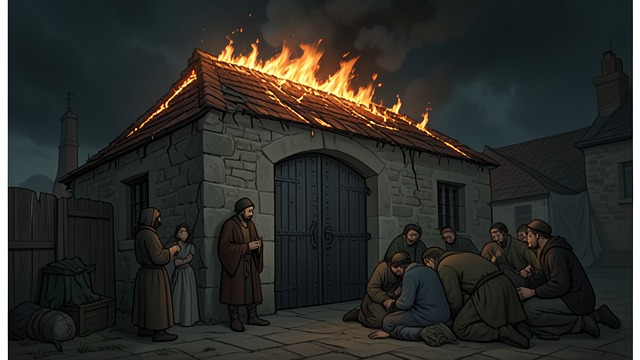
Bombs strike the village as several hundred prisoners are locked in a church. The roof catches fire, and the guards do not unlock the heavy doors.
Responsibility Under Pressure
The guards face confusion, fear, and the sudden absence of the men who commanded them. None of those pressures changes the fact that the prisoners burn inside the locked building.
The Daughter’s Account
Testimony at a Distance
The Fire Reconstructed
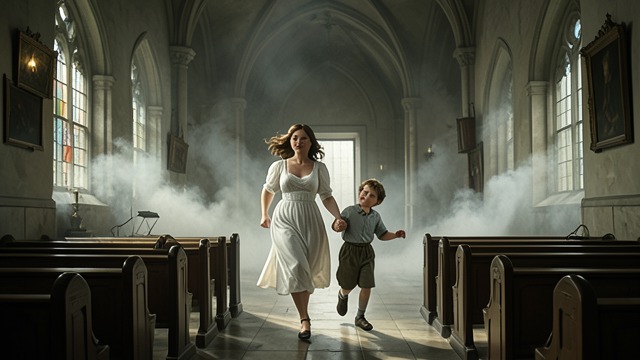
The daughter’s account follows the women’s slow realization that the church is burning, their cries, and their attempts to break through the doors. The fire becomes visible only after the danger is already advancing.
Survivor and Witness
The mother and daughter escape by retreating to a narrow gallery. Their survival does not make the account a simple story of rescue or forgiveness; the memory remains shaped by terror and contingency.
Hanna’s Explanation
Fear and Duty
A Guard’s Account
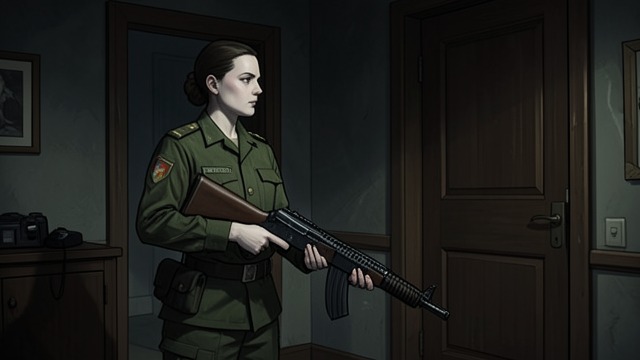
Hanna describes the wounded, the departing men, the weapons she cannot use, and the difficulty of controlling a crowd of prisoners. She says that the guards believed they were responsible for preventing escape.
An Inadequate Answer
The judge asks what she feared would happen if the doors were opened. Hanna struggles to explain, and her account makes the situation understandable without making the decision acceptable.
A Visit to Struthof

Seeking Material Reality
A Journey to a Camp
Michael travels to Struthof because the trial has left him unable to imagine the camps concretely. A driver challenges his assumption that extraordinary hatred must explain mass murder.
Indifference as an Explanation
The driver describes perpetrators who kill without personal hatred, treating victims as objects of indifference. Michael reaches the camp still unable to make its history fully real to himself.
The Impossible Balance
Two Obligations
Understanding as Risk
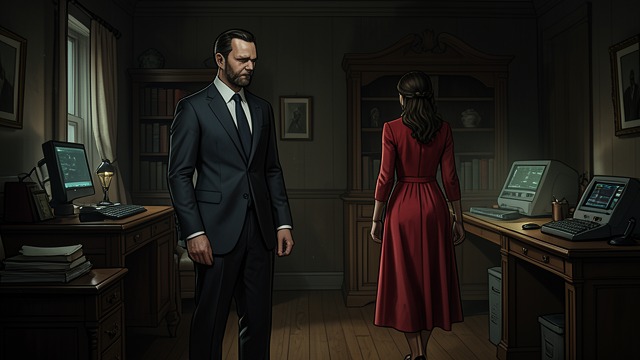
Michael wants to understand Hanna’s crime, but fears that understanding will soften the condemnation it requires. Condemnation, in turn, seems to leave no space for understanding.
No Resolution
He cannot resolve the conflict, and his impressions of the camp join the limited images already in his mind. The struggle remains an ethical burden rather than a conclusion he can safely reach.
The night of the bombing near Cracow
Years later, while Michael reads the memoir
During Hanna’s testimony on the fire
During Michael’s university years after the trial begins
The night after Michael visits Struthof
